
The Illusion of Calm: Takeaways from the MSA’s Q1 2026 Report
Alberta’s Market Surveillance Administrator (MSA), the province’s power market regulator, released its wholesale market report for Q1 2026 on May 14th. Spanning 80 pages, it provides statistics, event descriptions, and valuable insights into shifting market dynamics and emerging trends.
Given the low current pricing levels amidst rapid market, technological, and regulatory shifts and strong load growth, we chose “The Illusion of Calm” as the title of this post. Our key takeaways are summarized below, though reading the full report is still highly recommended: it is the clearest independent confirmation we have seen to date that current market conditions are unsustainable. We better get ready for far-reaching change - the time to prepare is now.
This article is for general informational purposes only and does not constitute financial, investment, or professional advice. Information is subject to change without notice and should not be relied upon for decision-making.
© 2026 Arder Energy™. All rights reserved.See Webpage Terms of Use.
Significant Outages
As we enter a period of strong, potentially decade-long load growth, tracking unplanned outages becomes critical as the province's comfortable supply cushion erodes. Q1 featured four notable disruptions that primarily impacted gas-fired assets:
January 5th: An unexpected outage at the Shepard combined-cycle plant, combined with wind generation missing AESO forecasts and insufficient lead time to commit offline gas-fired steam assets, drove the quarter's highest daily average pool price to CAD 363/MWh.
March 7–11: A mechanical failure on TC Energy’s 36-inch Fort McKay Mainline forced firm gas deliveries below 50% and cut interruptible service to zero, reducing fuel to local generators and pressuring pool prices.
March 25th: Unexpected wind asset icing sharply reduced renewable output. As this was unexpected, the AESO had not committed gas-fired steam assets that were commercially offline. And then, Block 1 of the province’s newest combined-cycle plant, Cascade, tripped at 09:24—dragging available capacity down to a quarterly low of 160 MW during HE 12.
March 26th: Planned maintenance and tight hydraulics on the NGTL system cut Fort McMurray firm gas supplies to 72% and interruptible deliveries to zero. Combined with planned outages at other thermal plants and low renewable output, pool prices surged to a quarterly hourly peak of CAD 949/MWh during HE 21.
Fortunately, none of these incidents triggered material grid blackouts, and the quarterly average pool price remained a low CAD 32.15/MWh. However, they serve as a clear reminder that even gas-fired generation is not immune to major disruptions. As structural demand growth erodes the capacity buffer over the coming years, the risk of reliability events will inevitably rise.
Unsustainable Prices
Right at the start, on page 4 of the report, the MSA makes an important statement:
“Net revenue analysis estimates the profitability of hypothetical generation assets using pool prices, natural gas prices, carbon prices, and assumed cost parameters. The MSA’s net revenue analysis for Q1 indicates that the hypothetical combined cycle, simple cycle, wind, and solar assets were all unprofitable over the quarter due to the low pool prices.“
But the historically low Q1 average pool price of CAD 32.15/MWh was not entirely the result of mild winter weather and an expanding physical capacity buffer. It was also the result of Unit Commitment Directives (UCDs) issued to generators that otherwise would be offline in order to have a large enough supply cushion. In Q1, 23 such UCDs were issued, and counterfactual analysis by the MSA indicates that these UCDs lowered the average pool price by CAD 2.44/MWh, or 8%.
In other words, current price levels appear unsustainable as they don’t support the generation growth needed to serve expected load—don’t count on them to last much longer.
Pseudo-Locational Marginal Pricing
The Restructured Energy Market (REM), Alberta’s most sweeping regulatory change to the power market since 2001, will introduce Locational Marginal Pricing (LMP) to the province. Instead of a single province-wide wholesale price, the market will feature over a thousand pricing nodes that reflect the impact of physical grid constraints on local supply and demand. Nodes without transmission constraints between them will share the same price, whereas locations separated by import or export bottlenecks can see materially different prices—even if they are only a few kilometers apart. This framework will provide sharper pricing signals for both generation and load, matching models already established in major markets like Ontario, ERCOT (Texas), and California (CAISO).
What will pricing look like in Alberta under an LMP framework? The MSA analyzed this by backtesting historical grid, supply, and demand conditions from 2020 through 2025 to calculate counterfactual pseudo-LMP (pLMP) data. As expected, rural areas surrounding renewable assets—primarily in the southeast of the province—frequently face significantly lower prices when power must be curtailed due to localized export constraints. The image below illustrates the calculated pLMP for October 2025. Because these pricing patterns shift dynamically based on the exact nature of regional grid constraints, a detailed review of section 2.2 of the report (pages 46–56) is highly recommended for those looking to explore the data further.
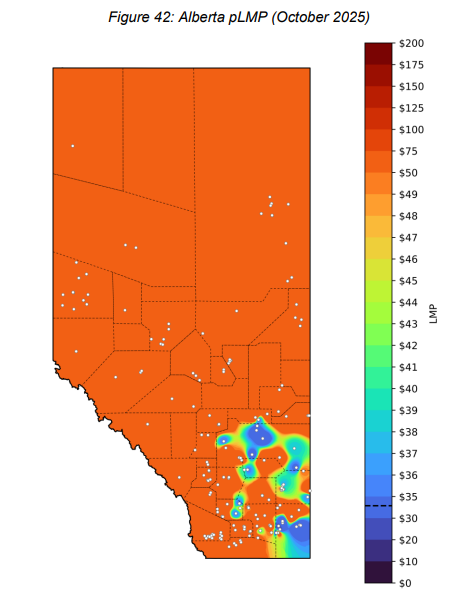
Alberta pseudo-Locational Marginal Prices (pLMP) for October 2025
Source: MSA Alberta, Wholesale Market Report Q1 2026, p.55
Implications
While we cannot predict exactly when this period of relative calm will end, something will inevitably give. Our strong recommendation is therefore to develop and implement a robust, resilient power strategy now; a ship is best repaired before, not during a storm.
📊 ArderInsights Platform: From Market Metrics to Operational Strategy
Good strategies require good data. The ArderInsights Platform translates complex Alberta power metrics into operational realities, providing industry and investors with foundational market intelligence.
📈 1. Free & Premium Market Dashboards
Free Dashboard: Live tracking of Alberta Power Market pricing, zero-dollar hour frequency, and load dynamics.
Premium Dashboard: Advanced tracking of price, load and flexibility metrics, with optional private data integration.
📋 2. Regular Market Reports
Detailed monthly reports featuring price distributions, load flexibility, and TB2/TB4 arbitrage analytics, delivered promptly after month-end, available to Members through our platform.
🎓 3. On-Demand Training
Foundational capacity-building online training modules designed to establish a solid baseline across technical, commercial and regulatory power market aspects, available to Members through our platform.