
The shortest month of the year is over, and the combination of ongoing structural changes to power generation and unusually mild weather delivered some remarkable price patterns to Alberta’s electricity market. Let’s dive in!
This article is for general informational purposes only and does not constitute financial, investment, or professional advice. Information is subject to change without notice and should not be relied upon for decision-making.
© 2026 Arder Energy™. All rights reserved. See Webpage Terms of Use.
The Data
Our usual big-picture perspective—the monthly price heatmap—shows an unusually “boring” landscape of muted colors, indicating widespread low prices.
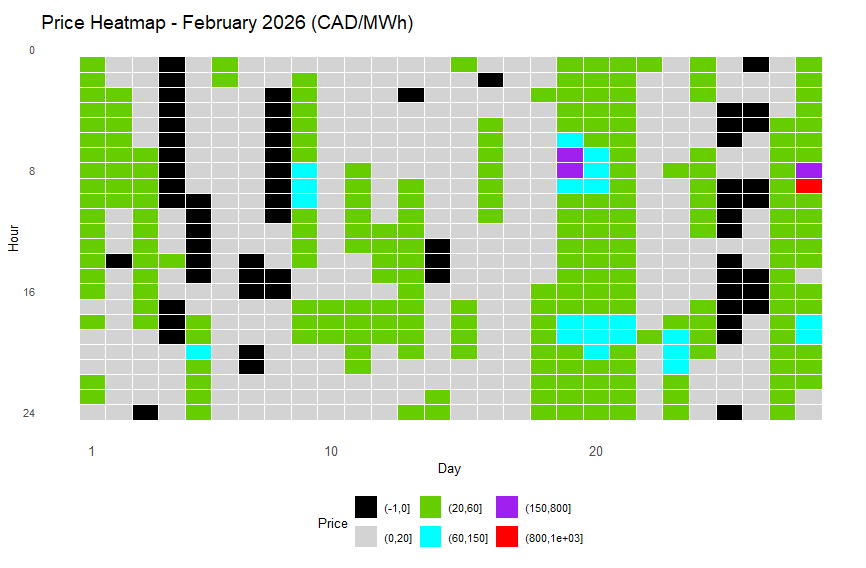
Heat Map of February 2026 hourly Alberta power pool prices
Black: zero dollar hour - “Excess Supply”
Light Grey: CAD 0.01 - 20/MWh - “Insufficient”
Green: CAD 20.01 - 60/MWh - “Marginal”
Cyan: CAD 60.01 - 150/MWh - “Full-cycle”
Purple: CAD 150.01 - 800/MWh - “Expensive”
Red: CAD 800.01 - 999.99/MWh - “Peak”
We see only four hours in the high hundreds of dollars; otherwise, the grey, green, and blue colors reflect very low to “normal” hourly prices, along with a significant number of zero-dollar hours in black. For anyone in the province during February, the unusually mild weather explains much of this muted price action, leading to a highly unusual year-on-year monthly average load decrease of 1.4% (see our recent blog, “Alberta Power: Growth!”, for a wider perspective on load trends).
But how does this compare to the second month of the previous 20 years?
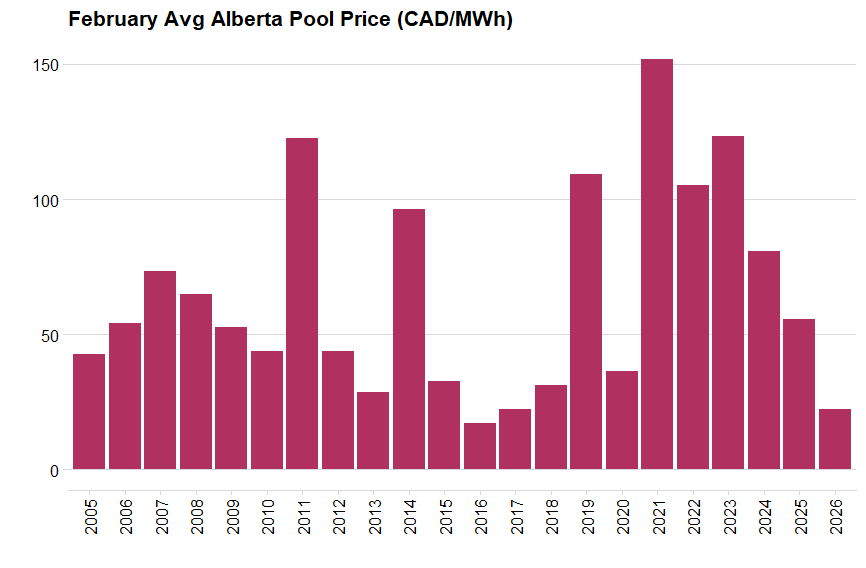
February average Alberta electricity pool prices, 2005-2026 (CAD/MWh)
Prices are not inflation-adjusted
At CAD 22.39/MWh, the average pool price was the third-lowest for February since at least 2005—even before adjusting for inflation. When we look at our price proxy for highly flexible loads (the average of the daily lowest-cost 8 hours), we see something even more extreme: it is the lowest level since 2005 by a huge margin. The next lowest average, February 2016 at CAD 14.08/MWh, was 42% higher:
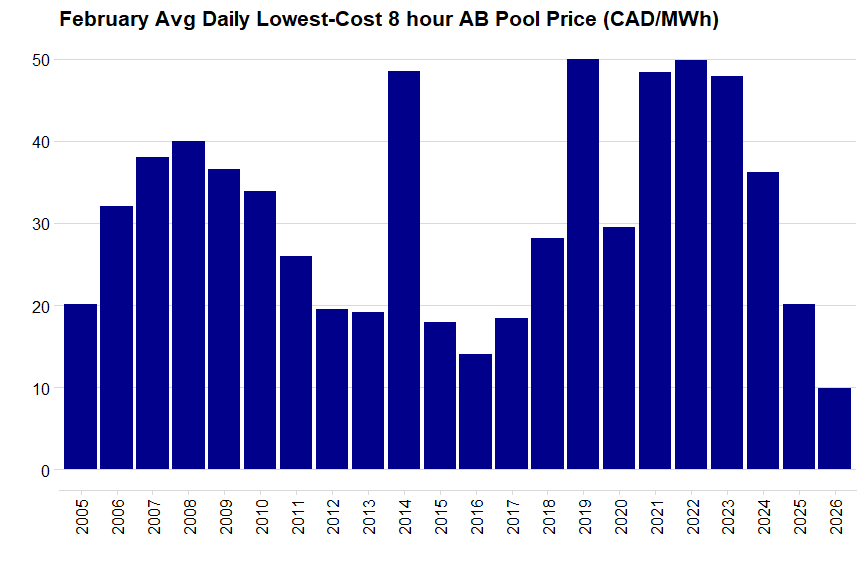
Daily lowest-cost 8 hours, average for February, 2005-2026 (CAD/MWh)
Prices are not inflation-adjusted
Given this data and the recent sharp increase in zero-dollar hours, one might expect another record in this category, but that wasn't the case. We saw 64 zero-dollar hours—the exact same number as last February. It is worth noting, however, that last year was already a major record; prior to that, only 2015 had seen any zero-dollar hours in February at all:
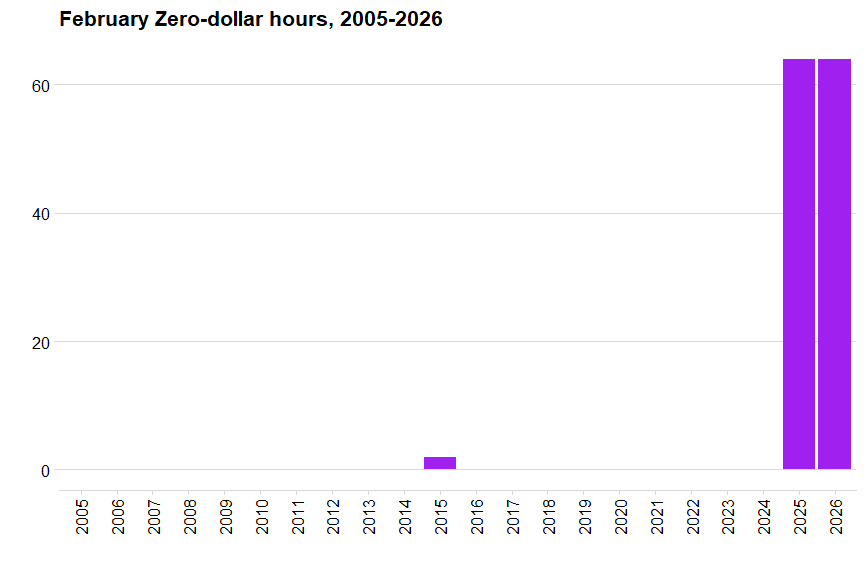
Monthly zero-dollar hours for February, 2005-2026
Matching last year’s record despite lower average load demonstrates the profound effect of the structural change in generation.
Conclusion
This brings us to the same conclusion as our previous reviews: Alberta’s power market continues to evolve, and the change is deeply structural, not cyclical. With load growth projected to be unprecedented—ranging from large to massive—and the most significant regulatory shifts since deregulation on the horizon, large industrial power consumers face immense uncertainty. This "calm before the storm" is the ideal time to develop and implement a power strategy if one is not already in place.
To help you prepare and deepen your understanding of this market, please get in touch to explore how we can help turn electricity from a cost element into a driver of competitiveness.
📊 ArderInsights Platform: From Market Metrics to Operational Strategy
Good strategies require good data. The ArderInsights Platform translates complex Alberta power metrics into operational realities, providing industry and investors with foundational market intelligence.
📈 1. Free & Premium Market Dashboards
Free Dashboard: Live tracking of Alberta Power Market pricing, zero-dollar hour frequency, and load dynamics.
Premium Dashboard: Advanced tracking of price, load and flexibility metrics, with optional private data integration.
📋 2. Regular Market Reports
Detailed monthly reports featuring price distributions, load flexibility, and TB2/TB4 arbitrage analytics, delivered promptly after month-end, available to Members through our platform.
🎓 3. On-Demand Training
Foundational capacity-building online training modules designed to establish a solid baseline across technical, commercial and regulatory power market aspects, available to Members through our platform.