
Alberta Power Market Snapshot: March 2026
This March, Alberta’s power market hit a turning point as new market records combined with long-awaited regulatory certainty. We now have a clear timeline for the largest market restructuring since liberalization. The 'structural shift' we’ve been tracking is well under way and augmented by new market rules. Let’s dive into the data and the timeline defining this new chapter.
This article is for general informational purposes only and does not constitute financial, investment, or professional advice. Information is subject to change without notice and should not be relied upon for decision-making.
© 2026 Arder Energy™. All rights reserved.See Webpage Terms of Use.
The Data
As usual, let’s start with the big picture: the monthly heat map of hourly pool prices:
While February was defined by a steady, muted calm, March brought back some color. We see significantly more variation, characterized by a tug-of-war between "black" zero-dollar hours and the “warm” colors indicating higher, more “normal” prices:
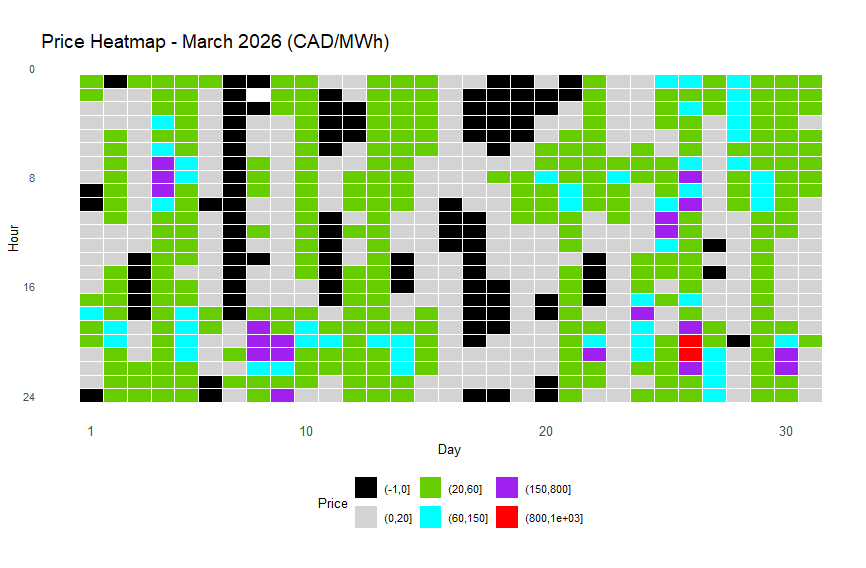
Heat Map of March 2026 hourly Alberta power pool prices
Black: zero dollar hour - “Excess Supply”
Light Grey: CAD 0.01 - 20/MWh - “Insufficient”
Green: CAD 20.01 - 60/MWh - “Marginal”
Cyan: CAD 60.01 - 150/MWh - “Full-cycle”
Purple: CAD 150.01 - 800/MWh - “Expensive”
Red: CAD 800.01 - 999.99/MWh - “Peak”
This volatility naturally pulled averages upward; compared to February’s remarkably low average of CAD 22.38/MWh, March surged by almost exactly 50% to settle at a still very low level of CAD 33.67/MWh. Despite that jump, it remains the 5th lowest March average since 2005, trailing closely behind last year’s average of CAD 34.76/MWh:
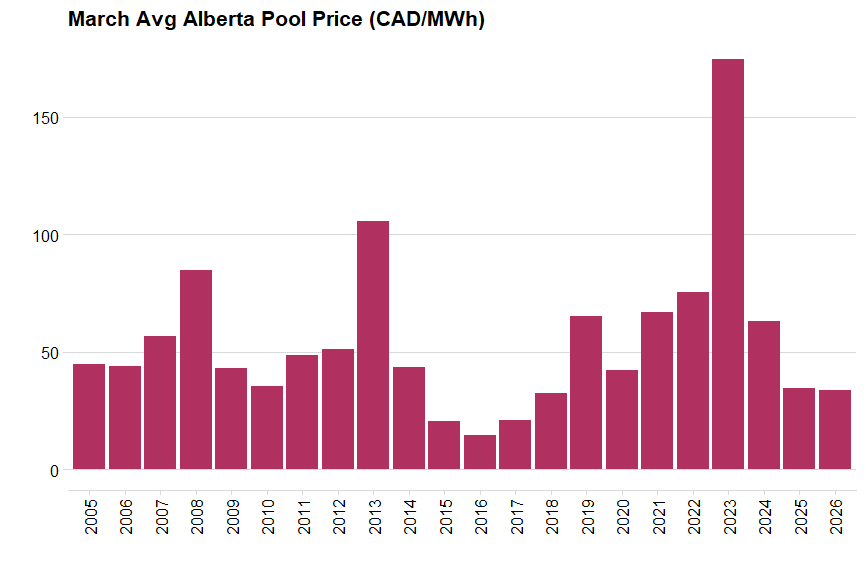
March average Alberta electricity pool prices, 2005-2026 (CAD/MWh)
Prices are not inflation-adjusted
However, looking at the distribution of those prices reveals a much more interesting story with opportunity for flexible players. The average of the daily lowest-cost 8 hours—our proxy for the value available to flexible loads—set a new record low for March at $9.60/MWh:
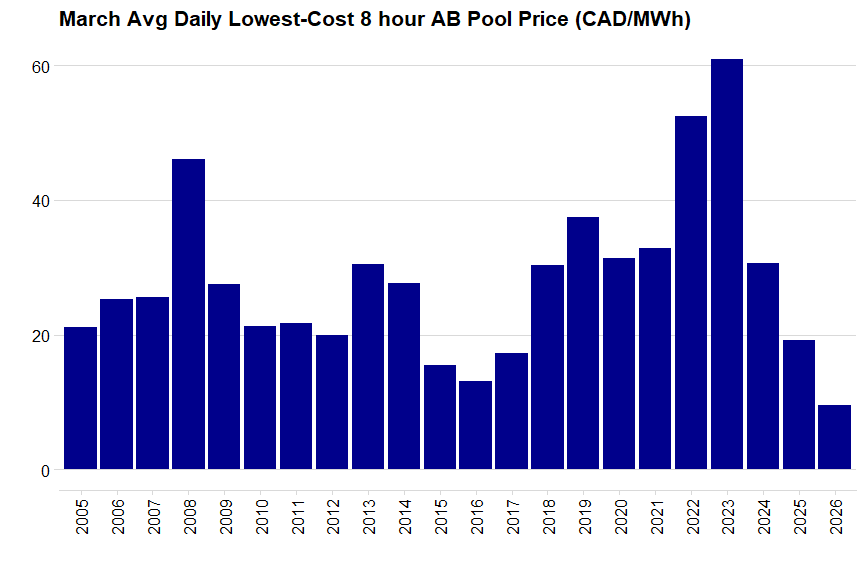
Daily lowest-cost 8 hours, average for March, 2005-2026 (CAD/MWh)
Prices are not inflation-adjusted
The driver? A massive spike in zero-dollar hours. Prior to this year, the March record was just 7 zero-dollar hours (set in 2025). This month, we hit 101 (!)—meaning almost 14% of all hours in the month were priced at zero in the wholesale market:
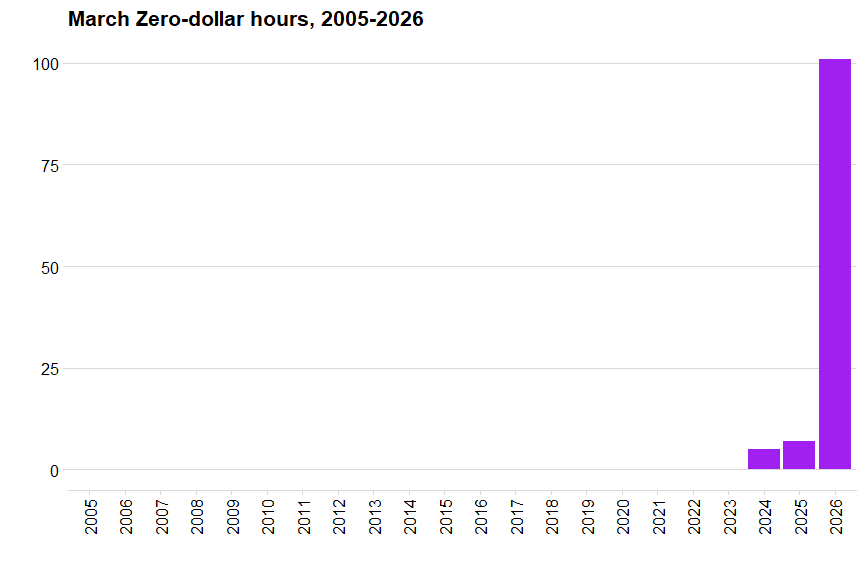
Monthly zero-dollar hours for March, 2005-2026
And the cause? Not a fluke, but the result of growing inflexible gas-fired cogeneration and renewables meeting a grid with limited storage and intertie capacity: the mechanism we outlined in our 2024 analysis, “The Change is Structural, not Cyclical!”.
Regulatory Change: The REM Roadmap is Confirmed
And a further structural shift is approaching fast. The Restructured Energy Market (REM)—the most significant overhaul since the turn of the century—now has a confirmed path forward.
Following recent updates from the AESO and Ministerial orders, the "go-live" date for the REM is officially set for Q1 2028, with a soft launch for system testing beginning in 2027.
Key pillars of the new market include:
Locational Marginal Pricing (LMP): Moving from a single province-wide price to hundreds of individual pricing nodes.
5-Minute Settlement: Shifting from hourly intervals to reflect real-time grid physics.
New Price Caps: A new scarcity price cap of CAD 3,000/MWh, with the energy offer cap rising from CAD 999.99 to initially CAD 1,500 at launch. And a new floor of minus CAD 100/MWh arrives by 2032.
Ramping Products: The new “R30” product will reward flexibility in generation and load.
Parallel to this, the Tariff Redesign work continues to reshape how transmission costs are allocated, potentially changing cost drivers for large transmission-connected loads significantly.
Takeaways: Preparing for the Storm
For industrial power consumers, we are currently in the "calm before the storm." While current price levels remain low, rapid load growth is already driving forward prices higher, and massive regulatory shifts are creating a new landscape of both risk and opportunity.
Now is the time to review and update your electricity strategies—industry still holds a high degree of agency in Alberta, but the window to act is narrowing.
The Good News: Flexibility is becoming a definitive competitive advantage, creating tangible cost-saving and revenue-generating opportunities.
The Bad News: Those who fail to prepare will find themselves at a structural disadvantage compared to their more agile peers.
In short, the era of "set and forget" power procurement is over, but for those who act, the opportunities in the power market will outweigh the risks.
📊 ArderInsights Platform: From Market Metrics to Operational Strategy
Good strategies require good data. The ArderInsights Platform translates complex Alberta power metrics into operational realities, providing industry and investors with foundational market intelligence.
📈 1. Free & Premium Market Dashboards
Free Dashboard: Live tracking of Alberta Power Market pricing, zero-dollar hour frequency, and load dynamics.
Premium Dashboard: Advanced tracking of price, load and flexibility metrics, with optional private data integration.
📋 2. Regular Market Reports
Detailed monthly reports featuring price distributions, load flexibility, and TB2/TB4 arbitrage analytics, delivered promptly after month-end, available to Members through our platform.
🎓 3. On-Demand Training
Foundational capacity-building online training modules designed to establish a solid baseline across technical, commercial and regulatory power market aspects, available to Members through our platform.